
Whiteout Survival Resources
Whiteout Survival has four main resources, Meat, Wood, Coal and Iron. Your city buildings make them, your marches gather them on the map, and items and events add more. Upgrades use them in a fixed ratio of 1 Meat to 1 Wood to 0.2 Coal to 0.05 Iron, so Coal and Iron run short first. This guide covers the sources, the best gathering heroes, the alliance exchange rates and the ways to keep your stock safe. Checked in November 2026.
Resources in Whiteout Survival
Four resources carry the whole economy, and each has its own city building, listed in the table. Each building produces on its own, and upgrading it raises its output. You spend all four on buildings, troop training, research and healing.
| Resource | City source | Gathering hero |
|---|---|---|
| Meat | Hunters' Hut | Cloris |
| Wood | Sawmill | Eugene |
| Coal | Coal Mine | Charlie |
| Iron | Iron Mine | Smith |
Other resources serve narrower jobs. Steel is a separate resource earned by exploring. It pays for Research Center technology and War Academy research, and it trades for Fire Crystal Shards. Fire Crystals, Refined Fire Crystals and Fire Crystal Shards belong to the Fire Crystal era: the first two pay for Furnace levels after 30, and the Shards pay for War Academy research. Gems are the premium currency, and one thing they buy is a temporary extra construction queue.
The research guide shows what Steel and Shards pay for in the War Academy, and the Furnace guide covers the Fire Crystal levels in full.
Resources Ratio in Upgrades
Almost every upgrade asks for the four resources in one fixed proportion. Meat and Wood come in equal amounts, Coal is about a fifth of that and Iron about a twentieth. The Furnace is the cleanest example, and the same proportion shows in the Storehouse limits.
| Item | Meat | Wood | Coal | Iron |
|---|---|---|---|---|
| Furnace 11 | 1.3M | 1.3M | 260K | 65K |
| Furnace 30 | 300M | 300M | 60M | 15M |
| Storehouse 1 protects | 5,000 | 5,000 | 1,000 | 250 |
| Storehouse 30 protects | 120M | 120M | 24M | 6M |
Meat and Wood costs are equal from Furnace 11 onward, while Coal and Iron vary slightly from one upgrade to the next. Troop Load follows the same ratio: a march carries its full load in Meat or Wood, but only 20% of it in Coal and 5% of it in Iron. Your upgrades ask for far less Coal and Iron too, so the ratio is the same on both sides and all four resources run out at a similar pace.
Gathering Resources on the Map
Your city buildings are only the base. To keep up with upgrade costs you also send marches to resource spots on the map. A spot gives a fixed amount of its resource, and your troops carry it home up to their Troop Load. Troop Load grows with the troop tier and is the same for every troop type of that tier, so a higher tier carries more per soldier and lets you send a smaller march to empty a spot. Heroes you send do not change Troop Load.
You can send up to three heroes with a gathering march. They add to the march size and, if you choose a gathering hero, to the gathering speed. When you send a march to a resource, the game normally picks the matching gathering hero for you.
Best gathering heroes
Four starting heroes each speed up one resource on the map. The bonus is the same for all four and grows with the skill level.
| Hero | Resource | Skill | Lv. 1 | Lv. 2 | Lv. 3 | Lv. 4 | Lv. 5 |
|---|---|---|---|---|---|---|---|
| Cloris | Meat | Predator | +5% | +10% | +15% | +20% | +25% |
| Eugene | Wood | Master Woodcutter | +5% | +10% | +15% | +20% | +25% |
| Charlie | Coal | Coal Extraction | +5% | +10% | +15% | +20% | +25% |
| Smith | Iron | Craftsmanship | +5% | +10% | +15% | +20% | +25% |
The bonus works only on the map. Each of these heroes also has a first skill that raises production in your city buildings. See the pages for Cloris, Eugene, Charlie and Smith for the full skill sets.

The video is a gathering guide: how to send marches to resource tiles on the map, which heroes speed up gathering and how gathering research adds to it.
More ways to gather faster
- Economy research. Gathering techs such as Food Gathering, Wood Gathering, Coal Mining and Iron Mining raise your map speed for good. See the research guide.
- Gathering Speed Boost items. They add 100% to gathering speed while active, so use one on a long march, not a short one.
- March queues. More queues mean more spots at once. Research and VIP raise the number you have, and the VIP guide lists the levels.
- Offline marches. Before you log off, send your marches out. Keep one queue free for rallies and events, and recall it before scheduled events start.
- Secured alliance nodes. These nodes protect gathering squads and give secured resources. They need Furnace level 16 or higher.
Resource Exchange
The exchange converts alliance resources into other alliance resources. Your personal city stock cannot be traded this way. It opens at about 45 days of state age and has a daily limit of 100,000 resources. Alliance resources come from separate alliance nodes inside your territory, and they pay for alliance buildings and Alliance Tech, not for your own upgrades.
| You give | You get | Rate |
|---|---|---|
| Meat | Wood | 2 for 1 |
| Wood | Meat | 2 for 1 |
| Meat | Coal | 4 for 1 |
| Wood | Coal | 4 for 1 |
| Meat | Iron | 8 for 1 |
| Wood | Iron | 8 for 1 |
| Coal | Meat | 1 for 1 |
| Coal | Wood | 1 for 1 |
| Coal | Iron | 4 for 1 |
| Iron | Meat | 1 for 2 |
| Iron | Wood | 1 for 2 |
| Iron | Coal | 1 for 1 |
The rates are not symmetric. Meat or Wood into Iron costs 8 for 1, but Iron into Meat or Wood returns 2 for 1. Converting plentiful Meat or Wood into the scarcer Coal or Iron always loses units, so use the exchange to fill one specific gap, not as a steady source. The Whiteout Survival calculator works out how many resources a given trade costs.
Secured and Protected Resources
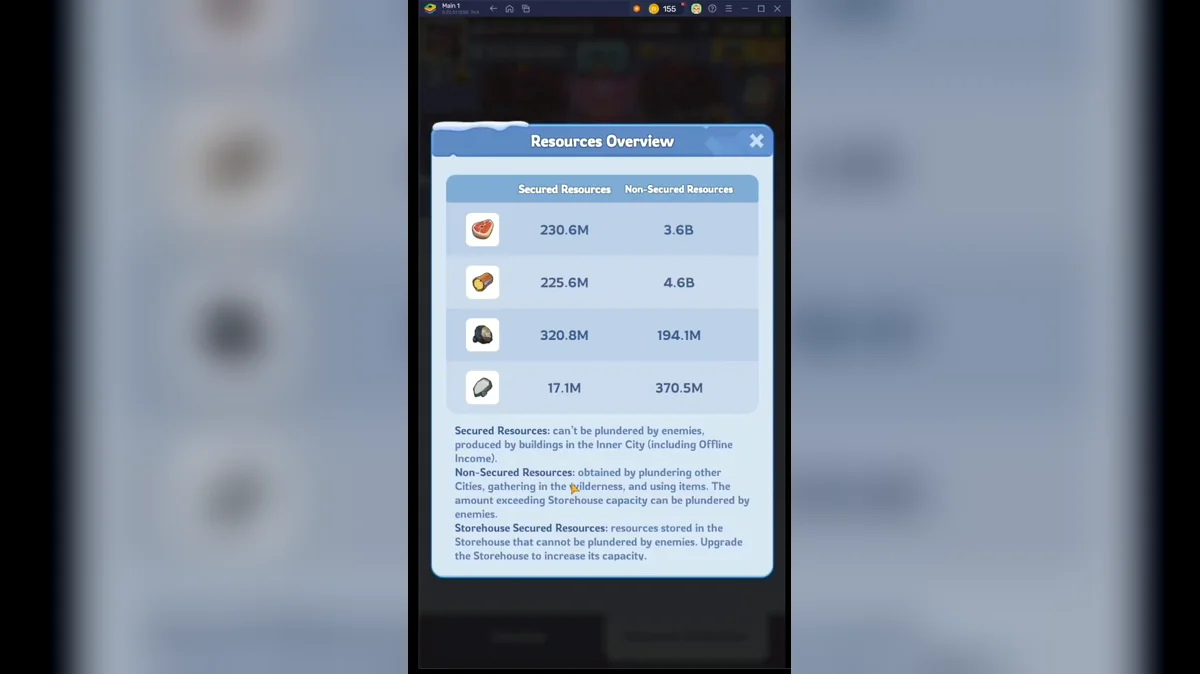
The game splits your stock into secured and non-secured resources. Everything your city buildings produce is secured, including the income you earn offline, and nobody can plunder it. Resources from plundering cities, from gathering on the map and from using items are non-secured. Non-secured resources above your Storehouse limit can be taken in a raid.
The Storehouse opens at Furnace level 9 and its limit differs by resource. At level 1 it covers 5,000 Meat and Wood, 1,000 Coal and 250 Iron. At level 30 the cover is 120,000,000 Meat and Wood, 24,000,000 Coal and 6,000,000 Iron. The calculator lists every level in between, and the buildings guide covers where the Storehouse sits in the upgrade order.
How to Save Resources
- Spend instead of hoarding. The best protection for non-secured resources is to turn them into a building or research as soon as you can start it.
- Keep resource items unopened. Items stay in the Backpack until you use them. Using one creates non-secured resources, so open it right before an upgrade.
- Upgrade the producers in spare queue time. Put builders on the four city producers when their output falls short of your next step.
- Pick the next step before you gather. Look at the Furnace window and its required buildings, then collect only what that chain needs.
- Hold the spare march. Keep one queue free for activities while the others gather.
Frequently Asked Questions
What are the resources in Whiteout Survival?
The four main resources are Meat, Wood, Coal and Iron, and they pay for buildings, troops, research and healing. Steel comes from Exploration in the Explorers' Cabin and goes into research. Fire Crystals, Refined Fire Crystals and Fire Crystal Shards appear later and pay for the Furnace and the War Academy. Gems are the premium currency, and one use is a temporary extra construction queue.
What is the resource ratio for upgrades?
Upgrades use Meat and Wood in equal amounts, about 20% of that amount in Coal and 5% in Iron. Furnace 30 shows it: 300M Meat, 300M Wood, 60M Coal and 15M Iron. Meat and Wood costs match from Furnace 11 on, while Coal and Iron vary a little between upgrades.
Who are the best gathering heroes?
Cloris gathers Meat faster, Eugene gathers Wood, Charlie gathers Coal and Smith gathers Iron. Each one has a gathering skill that adds 5% at skill level 1 and 25% at skill level 5 to that resource on the map. The skills are Predator, Master Woodcutter, Coal Extraction and Craftsmanship, and the game normally picks the right hero for the resource you send troops to.
How does resource exchange work?
The exchange converts alliance resources only, not your personal stock, and it opens at about 45 days of state age with a daily limit of 100,000 resources. Meat or Wood to Coal costs 4 for 1, to Iron costs 8 for 1, and Iron to Meat or Wood returns 2 for 1.
How do I protect my resources from plunder?
Everything your city buildings make, including offline income, is secured and cannot be plundered. Resources from gathering, plundering and used items are not secured, and whatever goes above your Storehouse limit can be taken. Spend resources instead of holding them, and upgrade the Storehouse in a gap in your queue.
Should I keep resource items in the Backpack?
Yes, until you need them. Resource items stay in the Backpack and are safe there, and using an item turns it into non-secured resources in your city. Open a chest or item only when an upgrade is ready to start, so the stock sits in the city for as short a time as possible.
Read Next
Plan your next big upgrade with the Furnace guide, see every building in the buildings guide, and run the numbers in the calculator. New players can start with the beginner guide, and the guides page lists the rest.